
Work Permit Deadline in Georgia (1 January 2027): Who Still Needs One
The 1 January 2027 deadline is close. See who needs a work permit in Georgia after the 2026 exemptions, how to apply, the fees and the fines.

The transition period for Georgia’s new labour-migration rules ends on 1 January 2027, and many foreigners who live and work here still aren’t sure whether the rules apply to them. Here is a plain-language check, the key dates, and what to do if you do need a permit.
What changed in 2026
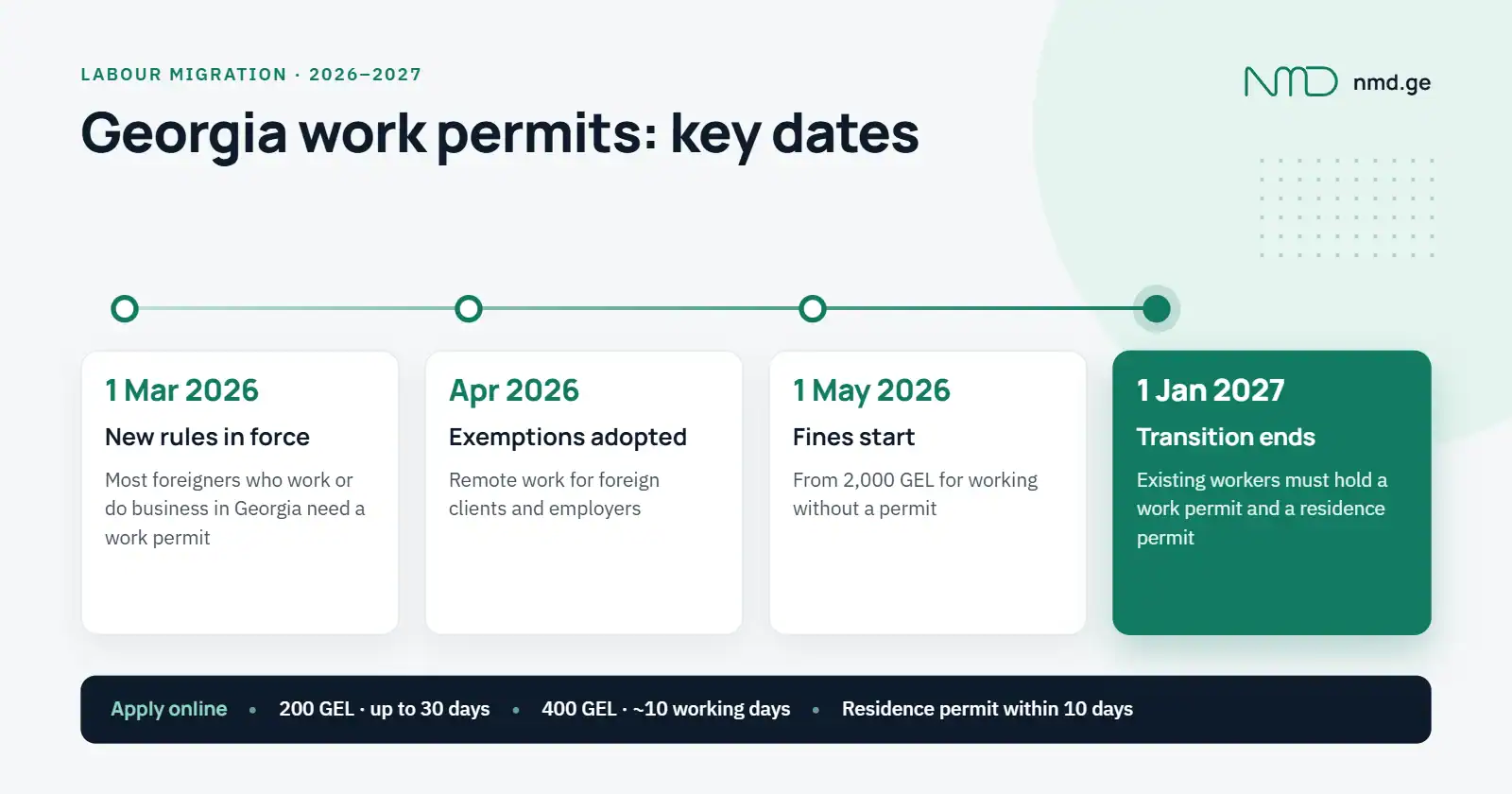
Since 1 March 2026, foreigners who work or run a business in Georgia generally need a right to work (a work permit) issued by the State Employment Support Agency. In spring 2026 Parliament added important exemptions for remote workers and people who serve foreign clients (see our earlier update). Fines for working without a permit apply from 1 May 2026.
Who usually does not need a permit
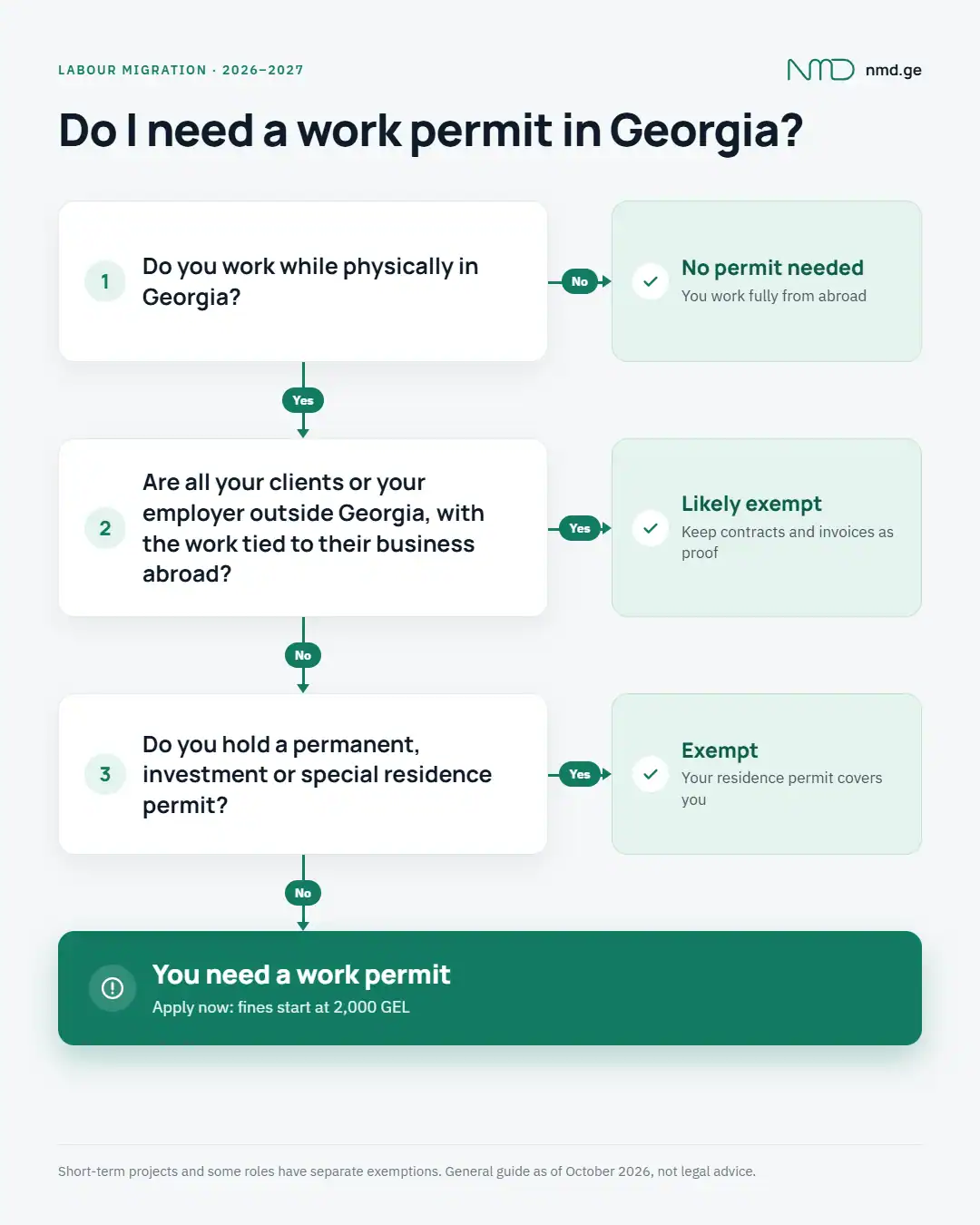
- You work from Georgia only for foreign clients or a foreign employer, and the work relates to their business outside Georgia.
- You work fully remotely for a Georgian employer and your job does not require you to be in Georgia.
- You come for a short-term project, training or event, within the limits set by the Government.
- You hold a permanent, investment or special (government-programme) residence permit.
- You are a director or supervisory board member of certain companies. Owning a share as a partner no longer counts as self-employment on its own.
Who does need one
- You have clients in Georgia. Even one local client can take you outside the remote-work exemption.
- You are employed by a Georgian company and work from Georgia.
- You run a local business here: a shop, café, tours or services sold in Georgia.
- You mix foreign and Georgian clients and can’t clearly show that your work is tied to business abroad.
Not sure? Follow the chart
The 1 January 2027 deadline, and why the self-employed shouldn’t wait
Foreign employees who were already registered in the Ministry of Labour’s database when the new rules started have until 1 January 2027 to hold both a work permit and a residence permit.
For self-employed foreigners and individual entrepreneurs the picture is less clear. Some law firms read the transition rule as also running to 1 January 2027, while others point out that fines for the self-employed have applied since 1 May 2026. If you need a permit, the safe move is to apply now rather than wait for the deadline.
How to apply
- Apply online on the labour-migration portal (labourmigration.moh.gov.ge) and state your exact field of activity.
- Pay the state fee: 200 GEL for standard review (up to 30 days) or 400 GEL for expedited review (about 10 working days).
- Once the permit is issued, apply for a work or IT residence permit at the Public Service Hall within 10 calendar days. If you are abroad, apply for a D1 visa at a Georgian consulate within 30 days instead.
- Keep your status valid: self-employed permit holders should not stay outside Georgia for more than six months in a row.
Fines for working without a permit
| First violation | 2,000 GEL |
| Repeat violation | 4,000 GEL |
| Further violations | 12,000 GEL |
For employees, the employer can be fined as well as the worker.
Exempt? Keep the paperwork
Exemptions depend on facts, not labels. Keep contracts, invoices and correspondence showing that your clients are outside Georgia and that your work serves their business abroad. That is what you will rely on if you are ever asked.
How Nomad Georgia can help
On a free 15-minute call we check whether you need a work permit, a residence permit, both or neither. If you do, we prepare the documents and handle the application for you. See our residence and work permit service or contact us.
This article reflects the rules as of 31 October 2026. It is general information, not legal advice; official interpretations are still evolving.
[…] working without a required permit can be fined from 2,000 GEL. Not sure where you stand? Read our work permit guide with a simple […]